Solutions


Marine Lightning Protection Inc.


HStripTM


A 0.5 ft2 immersed  grounding strip fabricated from  tinned copper


Overview


·         Dimensions of 36" x 2" x 3/16" provide 0.5 ft2 of contact surface when immersed.

·         Ground strip is fabricated from solid copper and tin electroplated.

·         Connector is 3/8" diameter tinned brass.

·         Detailed installation directions included regarding placement, precautions & installation


The Problems

The accepted method for a lightning protection system for a boat is to use a 1 ft2 ground plate and this is required in most lightning protection standards for watercraft.  While a copper ground strip offers the best conductivity, immersed copper fittings tend to turn green and corrode.  On the other hand, if bronze or stainless steel is used in the ground plate there are problems with the resistance of the connection. A preferable option is tin-plated copper.


Any immersed ground plate or strip can increase its effectiveness by means of the dynamic ground concept.  This is explained in Thomson (1991) and has been adopted by the major standards agencies such as ABYC and NFPA.  Basically, since sparks form preferentially from sharp edges, thereby increasing the effective area of the grounding conductor, the edges of a ground plate or strip should be sharp and exposed.  Also, for the same contact area, a long thin ground strip is more effective than a square ground plate. So the simplest geometry – a rectangular strip with sharp edges – is the best.


The connection to the ground strip needs to be at least equivalent to a down conductor.  ABYC and NFPA recommend a down conductor area of at least 21 mm2. In a typical  lightning protection system the connectors are the weakest links since it is difficult to make a perfect contact, so that a connection that is much larger than a down conductor is preferable.  Another difficulty is that readily available fasteners made of stainless or bronze have much lower conductivities than copper, and brass in not recommended for constant immersion.  So copper is best, but this metal is soft and tinned copper fasteners are not readily available.


A significant problem with the installation of any lightning conductor below the waterline is the risk of the through-hull connection causing an explosion during a lightning strike.  There are many instances of this happening and the result is a large leaking hole below the waterline. 

.

The Solutions

Our HStripTM has a contact surface area of 0.5 ft2 and provides four sharp edges to enhance the dynamic ground effect of the strip.  Two of these provide more than 1 ft2  of immersed area. Each is made of solid 3/16" copper and tin plated to 0.3 mil.  As such, two HStrips connected together with our HStripConTM internal connector can be used in any application requiring a one square foot ground plate or ground strip.  Or the two strips can be split up and placed one on each side of the boat just below the waterline to give a total immersed area of 1 ft2  that is closer to the waterline and can be positioned to shield other immersed fittings such as propellers, though-hull sensors and thrusters.


Both electrical connections and securing is done through identical 3/8" tinned brass bolts.  Electrical connection is made through a heavy duty lug for the down conductor connection, or a GapConTM spark gap connection if electrical isolation is desired.  If the spark-gap option is chosen, the HStripTM is electrically isolated from the lightning protection system for voltages less than 600V.  Isolation of immersed metals fittings reduces galvanic corrosion and eliminates electrolysis problems in marinas with ground current leakage.  It also dramatically decreases the possibility of introducing fault current into the water from inadvertent reversal of live and ground wires, which is a major cause of electrocution deaths from boat wiring problems.


Included with the HStripTM are detailed installation instructions, explanations of the hazards involved, and recommendations for precautions.  However, the main protective procedure we recommend is the addition of SiedarcTM electrodes to either terminate perimeter down conductors, or, with the daisy-chain connection option, to provide additional above-water grounding terminals and sideflash protection.  While our 1991 paper concluded that a one square foot immersed area was theoretically adequate in salt water, the statistics also showed that the electronics damage in a grounded boat in salt water was effectively the same as that in an ungrounded boat.  We feel that an external network of lightning conductors and bonded fittings is the key to effective protection.  Hence the HStripTM alone should not be relied upon, even in salt water.  However, it is the obvious first step.


Applications

HStrips in sailboat


In this application, the HStrips are installed on each side just below the heeled waterline approximately in line with the mast.  Hence we establish an equipotential region around the main saloon, as explained in Section 4.3 in our Grounding Concepts page.  Fig. 4-6 from this page is shown below, where the dashed lines represent surfaces of constant voltage.  No sparks are possible in an equipotential region where there is a constant voltage everywhere.


The two SiedarcTM electrodes above the waterline and outboard of the HStrips provide additional grounding terminals via spark promotion and lower the sideflash risk from the down conductor in the hazardous region near the waterline. In conjunction with  additional down conductors and SiedarcTM electrodes at the bow and stern, and the loop conductor at deck level, a protective conducting shield is formed around the whole interior of the boat.


HStripTM on Mirage Great Harbor N37


The optimal location for grounding terminals is as close to the waterline as possible so that the current has the shortest distance to travel to the water surface.. By placing the HStrips at the stern of Young America, a Mirage Great Harbor N37, we ensured a location that was continually immersed but at the periphery of the hull.  In addition, two SiedarcTM electrodes were installed abeam of the HStrips to provide additional down conductors and grounding terminals at the aft end of this passagemaker.  Another major advantage to an aft location is that the HStrips effectively shield the propellers.  Since the engine block was connected to the DC ground and hence to the lightning protection system, the propellers otherwise were attractive exit points.  To further lower the risk of lightning current damaging engine and gearbox bearings on its path to ground, Young America was fitted with an insulating coupling between each engine and its propeller shaft.  Also, to completely isolate all underwater fittings from each other and hence avoid galvanic currents in the water, we added a GapConTM spark gap at the connection point of each HStripTM.  The complete lightning protection system comprised two HStrips, six SiedarcTM electrodes, four air terminals, and a network of interconnecting conductors that formed a shielding grid around the boat.


More information


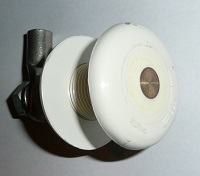
        Brief technical details and photos of the HStripTM, GapConTM and HStripConTM


        Prices & availability


Marine Lightning Protection Inc.

Phone: +1 352 3733485 
Email: info@marinelightning.com
URL: www.marinelightning.com


Photo by Gabriel Urbinaga

 Copyright Marine Lightning Protection 2008


Back to top